Showing posts with label Business. Show all posts

Liberty Books' Home-service: Awesome

I ordered a book online yesterday for the first time and in 24 hours, it's here all the way from Karachi with no TCS courier charges. Above all, with payment upon delivery!

Here's a book for record... Nassim Nicolas Taleb's much renowned The Black Swan.


Picture taken by yours truly

Models that Measure Customer Demand

I ran with my friends a small juice cafe in university. Unlike many Pakistani businesses which think about customer demand and all of it after spending millions, we searched for ways to determine, in fact, accurately measure consumer demand, elasticity of demand (i.e., effect of price change on customer demand of our products), quantity consumers would like to consume, product choice, prices, etc. We did that by giving samples to our faculty who we were not our customers actually (sounds funny isn't it!). Our customers were (poor) BSc/BA students only, for whom cost is a major factor, for they come to this university (confirmed from university surveys).

So we used widely used survey thing, without carrying out any reliability and confidence test. What our survey proved was that people on campus are addicted to cheap (& nasty) food. Not many care about the quality which has caused yours truly food poisoning for couple of time. And, that not many would love to pay more than Rs. 50 as regular customers. Because juices were different and each juice had 4-6 fruit or fruit juice(s) as inputs, it justified high prices of Rs. 70-80 per 450 ml glass. I visited Dunkin Donuts in Lahore, and they sell smoothie at Rs. 150. What can you do about ingratitude ! :P (Nah, I'm joking.)

The survey prediction came true. Sales fell as we moved forward. We ran out of friends. Repeatedly, our customers told us, often instructing us, to cut down prices. Unfortunately, we couldn't continue with low prices due to excessive end-semester workload, and had to close the beloved cafe. It has disappointed many, and if i get permission next semester, I'd definitely do it, primarily for my own self, I'm sick of low quality items sold. This experience is shared by many, hence I believe I can create value. Again, I need to research again, and that's were Marketing Models of Consumer Demand, a research paper Chicago & Stanford professor kicks in. It does just the thing.

Here's the abstract of the paper, and you can download its pdf from here.

"Abstract:
Marketing researchers have used models of consumer demand to forecast future sales; to describe and test theories of consumer behavior; and to measure the response to marketing interventions. The basic framework typically starts from microfoundations of expected utility theory to obtain a statistical system that describes consumers’ choices over available options, and to thus characterize product demand. The basic model has been augmented significantly to account for quantity choice decisions; to accommodate purchases of several products on a single purchase occasion (multiple discreteness and multi-category purchases); and to allow for asymmetric switching between brands across different price tiers. These extensions have enabled researchers to bring the analysis to bear on several related marketing phenomena of interest.

This paper has three main objectives. The first objective is to articulate the main goals of demand analysis - forecasting, measurement and testing - and to highlight the desiderata associated with these goals. Our second objective is describe the main building blocks of individual-level demand models. We discuss approaches built on direct and indirect utility specifications of demand systems, and review extensions that have appeared in the marketing literature. The third objective is to explore interesting emerging directions in demand analysis including considering demand-side dynamics; combining purchase data with primary information; and using semiparametric and nonparametric approaches. We hope researchers new to this literature will take away a broader perspective on these models and see potential for new directions in future research."

Pradeep K. Chintagunta
University of Chicago

Harikesh Nair
Stanford University - Graduate School of Business

Why eSystems often fail: Change Management

Our professor talks about failure of implementation of technology to solve real-world business (including private/public sectors). It happens due to the gap between computer scientists/engineers and people who run processes/businesses/institutions. Yet another failure of such mass-level system: "Minister [of education] admits failure of e-system (for roll# slips)" (Dawn, Wed 9 March, p. 13).

Education ministry was supposed to give all roll # slips electronically; 17,000 roll # slips given manually. Maybe because they didn't do the ground work; without involving someone who understands every aspect of the business and understands what would be the benefits of the technology to the business.

People get over-excited by benefits of technology, but often fail to understand change management issues, both technical and behavioral. For instance, i worked on the pre-feasibility of online tuition center. Where you can lecture 40 students in a classroom, you can now teach thousands online through Skype for free. You can now have a computerized adaptive testing system in which computer adapts to the ability of students and give simpler questions to a struggling students, or more difficult to an expert one - helping each master at their own pace. We can create earning opportunity for so many talented teachers through 1-to-1, 1-to-many online tuition, textbook solutions, homework help - btw, this is not novel, its being done via Grockit.com & Cramster.com. Problem with these sites is that they don't offer local language education and require credit card payment. Fortunately students in Pakistan can now pay their bills via easyPaisa.

But there are many technical & behavioral challenges to it. 1st technical issue which can wipe out this business model on day 1 - load-shedding! 2nd, internet connections may not be very fast & reliable.

When you come to behavioral issues - these are really subtle. Some go to academies just for friends, some due of fear of teachers who force them, some may not adopt eTuition just because its not done in physical world, some would only go to an academy because their parents want them to. All of these have their own solution, fortunately! For instance, by creating a game-like, socially competitive learning environment - learning experience online can be very addictive when you can compete with students in quiz, practice session. Ever saw those badges on Khanacademy.org? It serves the purpose.

Point of working in groups

Professors tell us that in real world team players are demanded. Working alone and in a team is hugely different for psychological and social reasons. The fact that you can face criticisms on your thoughts can be disturbing especially if the members are not glued together already. The point really is to get us debate about grey areas, and come to agreement using some objective criteria.

Working in teams suppose in a business should be have clear "rules of engagement". What i mean is that although we're not enemies, but since we're often excited about the venture, we forget to deal with each other like strangers. Hence, when i and my 3 friends launched a small venture of juice cafe in our school, we made it very clear what our values were, although there used to disagreements, because not everything could be foreseen, especially when making critical decisions about business, like pricing, budget spending, etc. i want to emphasize on corporate structures of even a small firm. What happens in over family business is that things are not worked out, nobody decides how time would one person work, and what would be his job description. That can leave space for lots of commissions and conflicts for future...

My Entrepreneurial Venture: Long way to go

We've planted a seed of a start-up. We wish it goes a long way. i wanna talk about elements of success and appreciate how "smarter our parents" - in fact smartest!

Its all about perseverance some say. Our professor talked about Pakistani businesses. He said that they are not doing any thing brilliant - making fans, constructing houses, etc. Yet making a fortune. They do things consistently over a number of years. Now a days we've this trend where people do one thing, then leave it and move on. When you meet them after 20-30 years, they're still saying, "Ah, i'm going to do something great soon." It never happens, because perseverance is not a part of such entrepreneurs.

As i reflect on our juice cafe. i've been exposed to things related to this business - customer perceptions about food brands, having just-in-time production system, food hygiene & other bio-tech problems, accounting systems for such a business, etc. I've opportunities to grow. I'd better grow in this sector than haphazardly starting another. i can diversify and move to other food and drink items; its essence remains the same. What i can leverage over the number of years by having a staying power, i'm more likely to do innovations and remain more competitive than a start-up.

But that does not mean i cannot or should not start other businesses if i can. The example that i'd give also explains how smarts our parents are, who're doing businesses or remained part of markets over decades. My father today discussed with me the idea of exporting straws produced as by-products from crops such as wheat. He made an accurate calculation of investment and found that one can make 200% profit by collecting this waste which many people here burn (hence increasing its price), making its batches and storing to wait for the time of export. He is mashaAllah already into many diverse markets. One of my friend's father also has done so many things which are herculean. He made that point.

Trade Ethics

I with my college friends have started a small business in university to learn ground truths. I saw the application of Islamic ethics of trade, and why evil is the opposite. Whatever code of ethics has been made by Islam, it is to benefit humans, both as entrepreneurs and consumers. For instance, telling the people right information was not being encouraged by some of us who are running the firm. They're reluctant and fear short-term losses. But, that's only hiding our own shortcomings. What if consumers come to know about the fact that strawberries are not being added to the drink, but some powder form of it! They'll spread bad word about it. But above all, the best way to implement these codes may not be policing firms but inner consciousness in humans.

Visit to a Factory


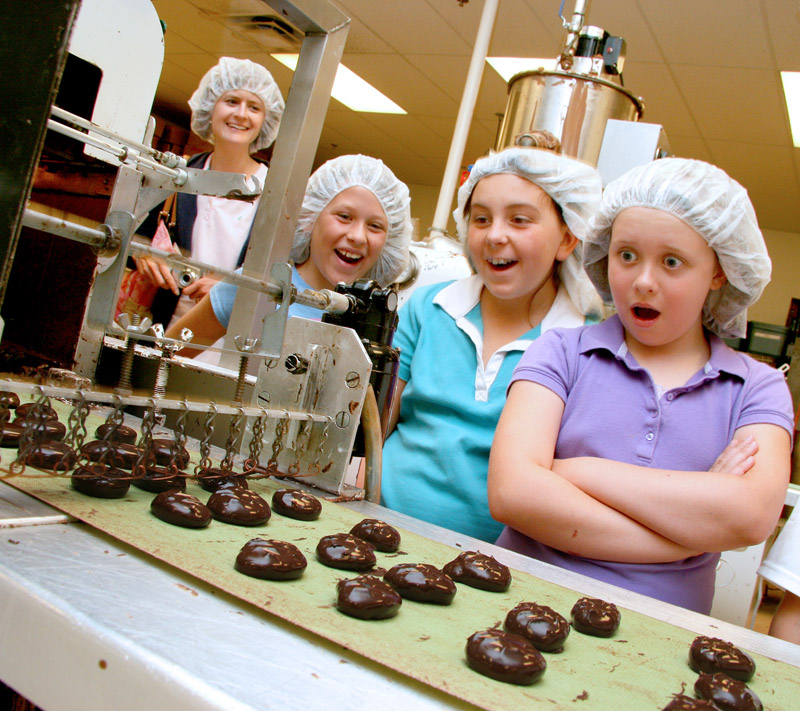
(How things are made: same expressions as mine, although chocolates were badly missing from the highly mechincal and electrical scene)


Last semester i was studying production planning and controls - useful for firms that manufacture where demand is uncertain and it has to decide how to much produce, but also useful for scheduling, sequencing of jobs, marketing, etc. So my senior told me about his friend who runs a factory and has welcomed to do course project on his company, especially in inventory management. As i had already done half the work, i had to let it down.

This semester we contacted and met, and today we finally paid first visit to the factory with the owner who is an engineering student in mechanical. The visits got cancelled due to a geniune problem. we rescheduled and then, thanks to my ability to do work at 11th hour, i had to cancel visit as i had to go to another firm... We Pakistanis are very good at it!

I'm learning how to run factories, and i haven't been into a factory before, apart from a textile mills which was very machine-intensive, but i learned production planning and saw concepts in action. We've been learning lean production tools which is about reducing waste (like, time, transport, handling, defects, wrong worker motions, etc.), achieving full worker involvement in continuous process improvements, and stuff like that. The way we're learning these things in the class room is genuinely amazing for we do things using Lego blocks, simulating factory environment here. (Here's such a class demonstration from MIT lean academy session: Lego Simulation.) That's been a very effective teaching environment. Now i feel ready to do it in friend's factory. And that's exactly what we'll do next time.

The firm produces some electrical devices on demand that means they don't make anything extra or less. And since product is big and parts or not made or assembled on a moving assembly line chance of defects, as per the friend (= owner), are almost zero. I don't know where the losses are taking place, or where the inefficiencies lie.

Nonetheless, we began the tour of the plant by switching on tv and watching a glimpse of Pakistan's cricket match (and yes we won against Australia! Yahoo! - by hook or crook, indeed by pure luck :P). i commend myself for having the sensibility to be ready to give up watching match because i understand "opportunity costs". Off the topic again. Owner took me to the floor. I couldn't see everything of the plant from one point, although i could see 75-80% of the work station. Because of small space it looks like a mess, and that's a problem they're working on, we'll talk about problems later.

He introduced me to the product by familiarizing with the machines, its process, the material machine deals with. We went through all the work centers and process step by step; i saw the product transforming from totally raw metal sheets to highly sophisticated electrical panels used in grid stations. It felt good to discover the product from scratch to finished-good. I felt manliness in that rough and tough, and noisy environment. This is what men are created for (at least partially) :P - biologically and psychologically speaking. This is where metal was crushed, bent, grind-ed, welded, polished, painted, heated, given bath of acid water, phosphate and what not. Then, taken to electrical parts assembling room where locally manufactured (in the company and else) and imported parts where being carefully assembled in a quiet fashion, although background music was generated from mechanical shop.

We sat in the room and talked about the problems, things that we could do together and i as independently. He explained the process flow by drawing a diagram of the factory, i got to make it on visio and on Flexsim, do remind me (i'm talking to the blog... :P).


This is called As-is Process Model where we show what processes are exactly happening - be it how you register for a college, or how you make a car. For illustration see the following picture - fun isn't it!?

Opportunities/Problems with the hidden factory: Spring To-do List
- Time & motion study of each process with a normal worker

-There's no documentation of bill of materials (which shows which materials are used & its details), or the process (of manufacturing, assembling, etc.)

- There are safety issues due to disorgazined work flow

- There are no visual instructions which any person, even if he's dumb and deaf can see to understand what to do without asking anyone

- Space: there's less space and more things - got to think out of box here

- Line balancing: got to organize the physical location of work centers/machines in which workers don't have to move any where

- Cycle times

- Cost accounting: would be an interesting exercise to invoke old concepts.

Doing less but quality work is the key my friend...

Vending Machines: A Dream Gone Sour

Dawn Lahore, FRIDAY, SEPTEMBER 24, 2010. See page # 10, read an article by Miwa Suzuki.

Now, i bought this book on starting up a business of vending machine, which i didn't know about the time i bought it. Since it was published by a magazine called Entrepreneur and was about entrepreneurship, so i bought it blindly, also it was quite cheap. "People respond to incentives."

Today I read this article (see top) about flourishing and much saturated vending machine market in Japan, with only 2.5 million drink-selling machines generating 27 billion dollars last year. They've placed it everywhere from streets to the 'icy summits of Mount Fuji'.

So, this seems like a dream business idea. Pakistan's is filled with the absence of these machines. We can do reverse engineering and reinvent and redefine what a vending machine is, and spread it everywhere!

There's one little problem, and difference b/w how things work in Japan and Pakistan. In Japan, people are not the likely to crime than in Pakistan. That's why they've spread it everywhere.

I talked about this v machine to the cook at home. I surprised him how they're selling chilled bananas with mind-reading devices (that can tell with 75% success rate what you'd like most to purchase), and he said, "Yahan tou banday nahi miltay, machine kya bachay gi!" ('Here people are missing from home, who cares about a vending machine.')

I stopped day-dreaming and went back to my Philosopher's Corner in search of a billion dollar idea!

One Sinister Enemy of Learning: Fear

Cost/managerial accounting is a major business course which all students of management go through. It is taught by one of most established and expert teacher/scholar in Pakistan. It has reputation of being unaccessible to simple-minded people who lack intellectual rigor. I was afraid of it, thanks to word-of-mouth of seniors. But that's just an external excuse. It was my internal mistake (a cause) that made me nervous about it, as i had to think hard about this course. I enjoyed being in class and solving cases and problem as instructor was there, who was also very accessible to us and went to great length to answer our questions, no matter how stupid. Nonetheless, when it came to self-study, i often had problems breathing well. especially when i attempted to understand its intricate theory and frameworks and tried to apply it complex cases (which is very typical of case method). Data used to be huge and thinking/intellect had to deployed in platoons to tackle any topic in that course. That's why it was fearsome

However, final papers turned to be good due to organized dedicated, directed and group work: this gives us an insight into how to succeed in exams on last day - with a disciplined friend, we systematically chased each chapter and won over it being very consistent over a span of 12-14 hours.

To say the least, this is one of most valuable courses (especially its book) i've have took in business. For instance, one recent grad of my school of management working, although as non-accounting operations management told me how useful this book on managerial accounting had been on the production floor - each day he had to refer to it, literally.

It all came back the memory of it as flash back when i was browsing through SSRN.com and found a paper on Activity-Based Cost accounting, which is a hot field in managerial accounting these days. We studied it as well. . I quote the excerpt of the abstract to illustrate my point about uselessness of fear when it comes to learning:

[Excerpt] It is essential to understand that ABC is a method that tries to frame data in a managerial decision making context. Models, figures and theories only have value to the extent that they help us to understand and explain what happens in the company. ABC is an allocation method cum story: it is an arbitrary way to allocate costs - as arbitrary as any other allocation method - but it helps in communicating how the (production) process works and, therefore, tries to upgrade the value of accounting in the decision making process. If, e.g., a good driver is found and if there is statistical evidence that supports the choice of and/or work-floor feeling on such a driver, using this cost driver in the calculations of product (line) profitability makes the accounting much more vivid and important to decision making.

Mr. Van Schenkel, founder and owner of small company producing colour printed T-shirts, has some ideas on why multi-coloured T-shirts are more expensive in production than T-shirts with fewer colours printed on them. Process mapping and accounting data are available to set up an ABC system that will allow to test the validity of Mr. Van Schenkel's ideas and to come to better accounting calculations of product profitability.

You can see how the author is applying theory and making it practical. This is a simple demonstration of higher level of learning: experimentation, application = usefulness. Had been more fearless of the burden of reputation of the course and its demanding nature, i'd have turned out to be a better citizen. And i happy i have learned this insight.

See the example and you'll get just how useful the concepts of managerial accounting is for entrepreneurship, SME's and all kinds of organization. It should be all research (read: play) with all seriousness - I'm not denying pain at all, which is part and parcel of (higher) learning. nothing can help a too fearful and shy a learner in the path of getting useful knowledge. To say the least, one has to be fearless in outlook when s/he approaches knowledge. And habit of tinkering with stuff be encouraged. It's an engineer's attitude, that's why we trust them.

What are your comments?